

Pretty much everyone who’s lived in the West long enough has at least one fire story. Particularly if you grew up deep in Intermountain territory, as I did.
I wasn’t in Spokane when fires chewed through part of the city on August 1st. I no longer live there, so I can’t trace for you what was lost or what it means for the community, as other writers can and have, beautifully. My response to the Spokane fires was delayed, induced by a different fire in another place, and it left me overwhelmed by the question of how to make sense of our changing West.
I’ve spent a lot of time driving between Portland, Boise, and Spokane. I-84, 395, Idaho 55, I-84 again. And again. I’d be interested to see the data, a hard accounting of the hours and ideas and passions and decisions influenced by those stretches of road. In many ways, I feel most myself when I am alone in a fast-moving car on a Northwestern highway. I am deeply at home traveling connective routes between here and there, this identity and the next, and pausing for rest at the interstices that unburden me from myself. I’ll pull off at the Stanfield Eastbound rest stop to eat lunch out of my hatchback and watch wind in the bunchgrass, or trawl far from the highway for pitas and loaded Greek fries in La Grande. Hit the last Subway sandwich shop north of Pasco. I’ve been going to these places for years, and nobody knows me. I love it. The balance of familiarity and anonymity clears my head.
Fittingly, the reality of the Spokane fires caught up to me as I was driving I-84 a day or two after the worst of the burn. My husband and I were headed home from Boise. No more than an hour into the drive, we passed a crossroad called Dixie, swept north through a turn, and found ourselves at the foot of a different fire. Though it had shut down the interstate only days before and smoke obscured the sky for miles, the Fox Fire in Baker County seemed to come upon us suddenly. The canyon that 84 follows shrugged away, and there it was above us: a wall of charcoal smoke rolling heavenward, roaring straight up off the ridge a few miles from the road.
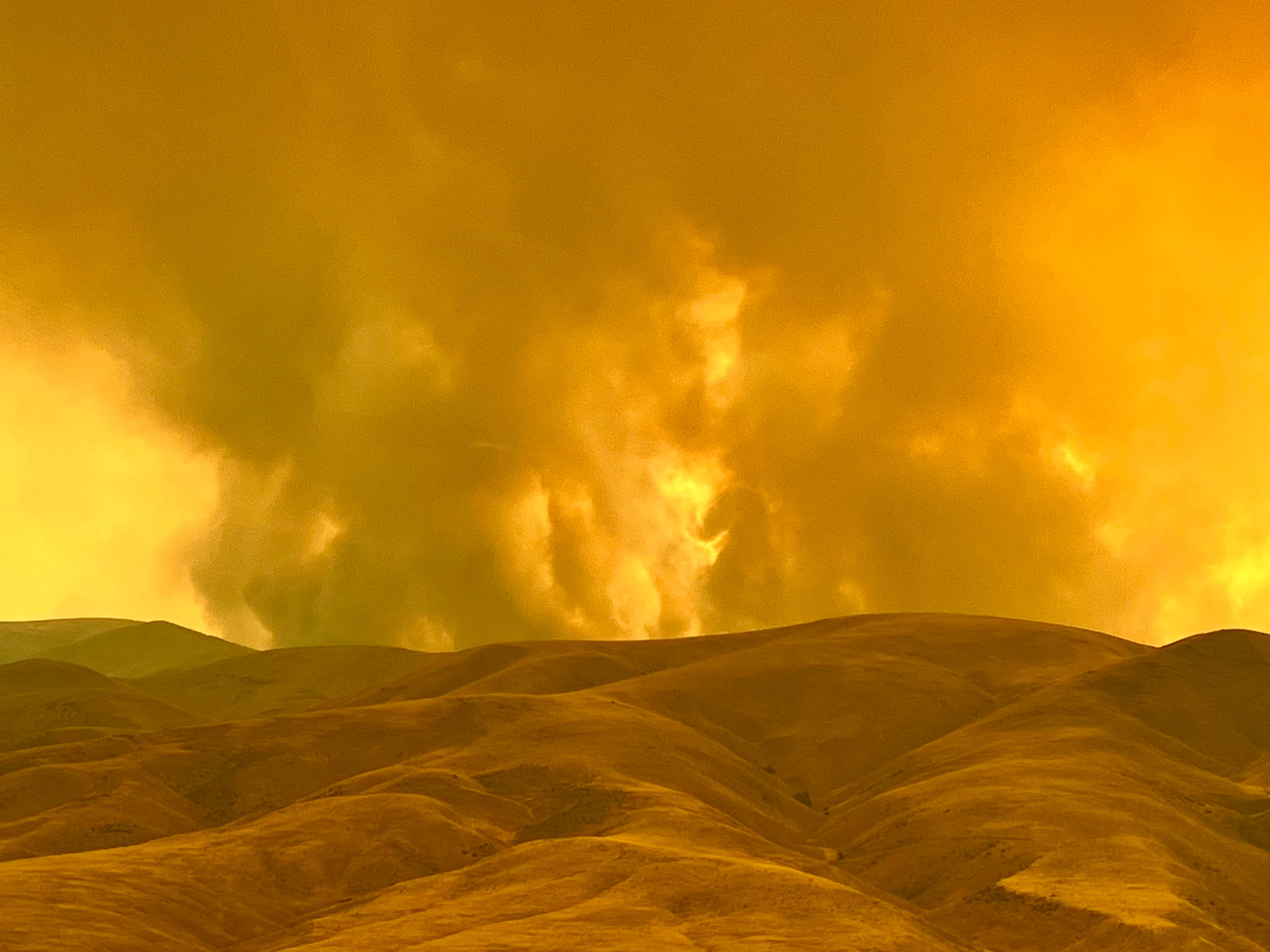
Traffic slowed. From certain angles, flames winked visibly, buffeted by the wind, furious and terrible to imagine up close. The sky at a certain proximity to wildfire glows orange, and the air was soot and ash.
Maybe you know. Maybe I don’t need to describe it.
It wasn’t my first time seeing flames from the highway, but in this case I superimposed homes, trails, and streets I’d known in Spokane. Is it wrong to overlay the destruction of one fire onto another? Does it make the impact of the Fox Fire less visible? Maybe I made the old mistake of looking at rolling, open high desert and thinking it’s empty. Or maybe I was feeling the cumulative effect of fires that have grown increasingly voracious over the years, increasingly willing to remind us that loving a place doesn’t stop it from burning.
This essay is as much about me grappling with how, when, and why to write about fires in the West as it is about one or two specific instances. It’s me asking, perhaps a little desperately, what to do with the heartbreak and fear. These questions are as good a starting point as any, and it’s my most natural form of affection, this wondering, though of course I have no answers.
What lies beneath and beyond the struggle to coexist with climate-driven wildfires in the West? Fire has long sculpted this part of the country and reflected human relationships with the land. Our relationship has gone off course, so how do we begin to understand and repair it? Importantly, where do we hope to end up, and what is the path between here and there? What highway heads that way? What will take us home?
Mix-Ins
A short list of experiences, events, publications, fun facts, etc., that are currently flavoring my days.
Since we’re talking of travel, I must mention that OMG! Chicken Shack (real name) in Pendleton has emerged as an elite pit stop roughly halfway between Portland and Boise. The drive-thru feels like pulling up to the rear window of someone’s house and the menu is inexplicably hard to parse, but the fried chicken is crisp, the french fries are memorably sliced (you’ll see), the restrooms are clean, the napkins are copious, and the dipping sauce selection has got to be unmatched for literally hundreds of miles. It is an oasis.

We have an unexpected battle on our hands at home. Our dog, Noodle, is Air Bud-ing it to snatch fruit from the lower branches of our pear tree because 1 (she eats anything) + 1 (she’s obsessed with orb-shaped objects of any kind) = 2 (no pear is safe).

Suggested donation is the average price of my preferred coffee (black decaf Americano, like a serial killer), which is currently $4.08 according to the first link I clicked in Google.
Looks quite terrifying...And your questions: What will take us home? That is way I study pilgrimages and have practiced pilgrimage. The journey is the main thing, not necessarily the goal. The journey can even BE home....
I started feeling very nostalgic when I was reading this piece. Specifically for that experience that you describe of knowing a place so well but then being completely anonymous.
After volunteering out at Rowena Crest for nine years, I felt that way in Hood River, my stop of choice. For me, there is no going out that way without having lunch at NY City Sub Shop, which also carries its own nostalgia since there used to be a location in downtown Portland before the building was torn down.
How to cope with the fires. What a question. I think for me it’s the belief (delusional confidence) that we as a people will get our act together and it will all work out. Or not, and we can reincarnate as something new.